

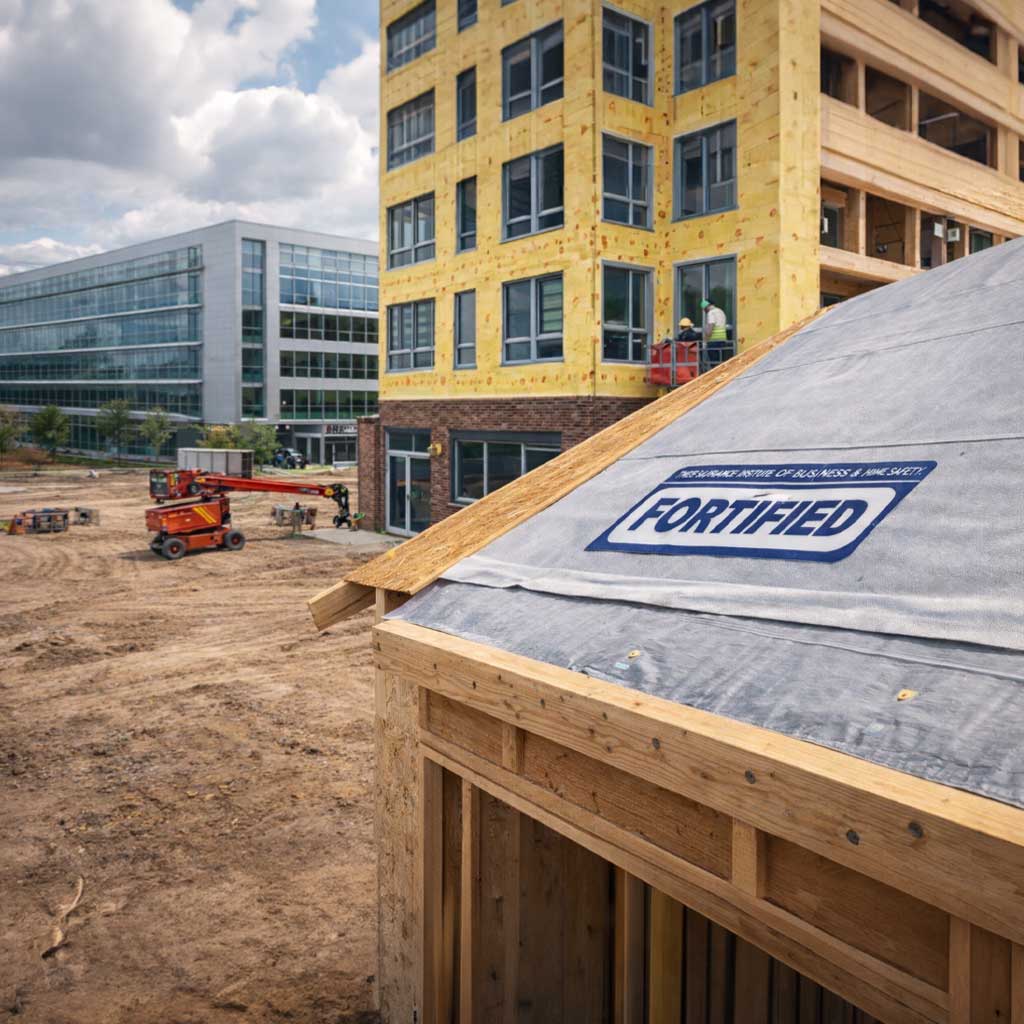
Every development decision begins with clarity — especially when resilience directly affects the construction cost, long-term asset value, and investor confidence.
Developers are now changing the way they approach risk because of rapidly changing weather patterns and insurance markets, and increased construction costs across the US. Climate change loss estimates are no longer 'nice to have'—they're a requirement.
At Developers Research, our role is to help our clients translate new realities into development feasibility, cost-accurate project estimates, and better decision making frameworks using one of the evolving standards, the Fortified Program, for the development process.
The Fortified Program, developed by the Insurance Institute for Business & Home Safety (IBHS), is a voluntary, beyond-code certification designed to strengthen homes, multifamily buildings, and commercial structures against severe weather events.
Developers, lenders, and insurers increasingly view Fortified as a differentiator — not only for risk mitigation, but for long-term operational and financial stability.
Stronger buildings require smarter planning — and that begins with accurate cost visibility.
Developers Research maintains an active, continuously updated pricing and fee database that reflects current market conditions, supply fluctuations, and regional construction trends. As resilience-focused standards such as Fortified become more widely adopted, we incorporate these requirements directly into:
Development feasibility studies
Early-stage cost plans
Risk-adjusted pro formas
Design and material specifications
Project and construction management frameworks
Key pricing considerations related to Fortified include:
Improved decking, sealed roof systems, and stronger fastening patterns typically increase initial material and labor costs — but significantly reduce long-term loss and repair exposure.
Stronger windows, impact-resistant glazing, and upgraded door assemblies carry a measurable premium.
Cost-effective and impactful, reducing post-storm water damage.
Fortified requires third-party verification, which must be reflected in early project budgets and developer evaluations.
By integrating these variables into our cost models, Developers Research ensures clients understand not just the premium — but the value and risk reduction associated with building stronger, smarter structures.
Our team is currently working with multiple clients to integrate Fortified requirements into their residential, mixed-use, and commercial development projects. For these stakeholders, the advantages go beyond weather resilience:
Lower long-term maintenance exposure
Improved insurance performance
Enhanced lender confidence
Better exit valuations
Greater marketability for investors and tenants
As insurers continue to reevaluate risk pricing — particularly in coastal and high-wind regions — resilience-forward design is becoming a central part of feasibility analysis and capital planning.
Our mission is to give developers, investors, and asset owners the clarity needed to make defensible, future-proof decisions. That requires more than historic data — it demands continuous improvement.
We regularly update our pricing database to reflect market shifts.
We actively incorporate industry-recognized standards, including Fortified, into our development analytics.
We model the cost implications of resilience measures with precision, giving clients transparent insight into both premium and payback.
Stronger buildings begin with stronger intelligence.
Resilient building standards are reshaping project economics and long-term asset value. As climate, insurance, and regulatory pressures increase, adopting frameworks like Fortified is becoming a strategic advantage for developers, not an optional upgrade.
Integrating these requirements early provides cost certainty, reduces lifecycle risk, and strengthens overall project feasibility.